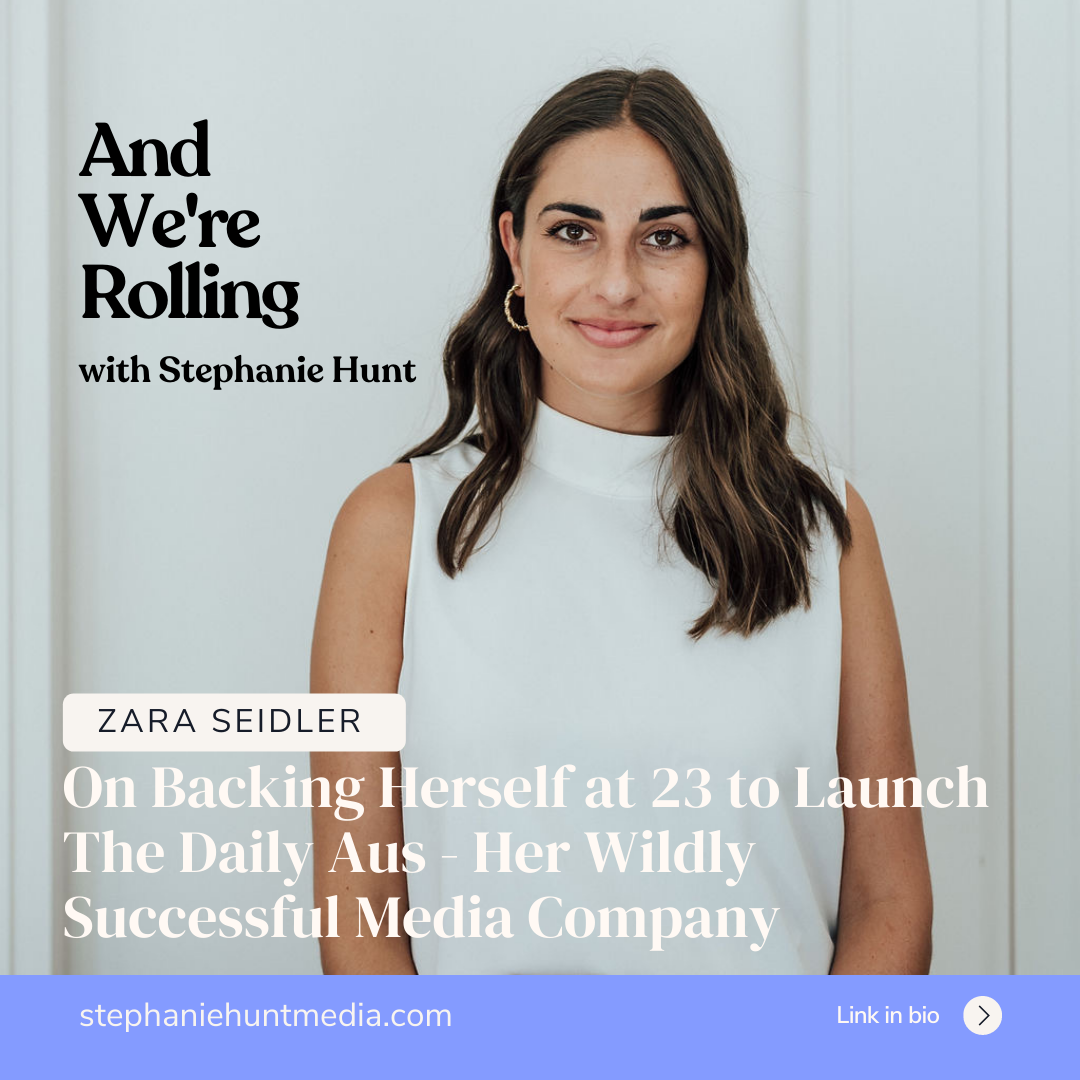
And We’re Rolling – Season 2
Steph Hunt interviews Zara Seidler, co-founder of The Daily Oz
Steph Hunt:
Zara, welcome to the show. Thank you so much for coming on.
Zara Seidler:
Thank you so much for having me. I’m really excited.
I was listening to some earlier episodes and I’m not quite sure how I’ll compare to them, but I’m excited for the challenge.
Steph Hunt:
At the moment, I’m looking at you via Riverside — we both use Riverside for our podcasts. You have an epic mic and a full green screen. I’m impressed. I’m intimidated already.
Zara:
It’s all about illusions, because this epic microphone is covered by my co-founder’s sock that he told me yesterday had gone hiking in Peru.
So it’s the small wins at this point.
Steph:
So it is actually a sock?
Zara:
It is a sock. Because we haven’t gotten around to being more legit yet.
So yes — it’s a sock that has been to Peru. At least we’re cultured.
Steph:
The stories that sock could tell.
Well firstly, huge congratulations on The Daily Oz. You co-founded it with Sam — owner of the sock.
It’s so successful. You’re absolutely killing it: an independent, social-first news service all about breaking down the big stories of the day, mainly for millennial and Gen Z audiences.
Where did the idea come from? How did you get it off the ground?
Zara:
I’ll answer the second part first, because this is something I always have to remind myself: it took a really long time to get rolling.
It definitely was not an overnight success.
We did it every day for four years, and only very recently did it become “successful” as such.
Sam and I started The Daily Oz because we were the friends everyone asked about the news.
We’d explain who the election candidates were, what mattered politically, what the latest overseas stories were.
We like to say we prepped our friends for dates.
So we thought we’d streamline it.
We started this little page called The Daily Oz. It was very small and lovely for a long time.
Both Sam and I were working full-time elsewhere, so it was just a passion project.
Then last year, the news blew up — and alongside that, so did The Daily Oz.
We were given the financial independence to take it full-time this year, which was huge for us.
And here we are.
Still pinching myself.
Steph:
It’s incredible.
What was it like quitting your day job and saying, Okay, this is it?
You also had to raise money and find good investors.
Zara:
It was terrifying.
A recruiter friend told me, “It’ll be so easy to tell your boss you’re quitting.”
He blatantly lied.
It was awful.
I’ve always been risk-averse and had set myself up for what I thought would be a very clear-cut career.
I was working in political lobbying and I thought that was it.
I could see a future there.
So leaving wasn’t easy.
Sam definitely had to do more of the pushing.
I was the resistant one.
Looking back now, that’s wild, because these last months have been the best thing ever.
But at the time, I thought I was jumping into something that could fail.
My family and friends pushed me.
And thank goodness they did.
Steph:
Did someone say something specific that tipped you over the line?
Zara:
Everyone kept reminding me how young I was.
I was 23.
If it didn’t work out, who cares?
Most people haven’t even started their careers then.
My mum especially — who’s also risk-averse — said:
“If it doesn’t work out, you’ll have ten more careers.”
That really helped.
Everyone around me saw something special in The Daily Oz that I couldn’t quite see because I was too scared.
Steph:
Thank goodness they pushed you.
And 2020 — what a year.
Zara:
Insane.
COVID revolutionised the way people engaged with news and politics.
Then the U.S. election. Then Black Lives Matter.
And this underlying climate anxiety.
All of it mobilised our audience in ways we’d never seen before.
Steph:
Millennials and Gen Z are often criticised as being stuck in their own bubbles and obsessed with social media.
But they care deeply about climate, justice, and social issues.
Zara:
Exactly.
That’s the core of what we do.
Young people aren’t complacent.
They just haven’t been spoken to properly.
Traditional media and politics often speak down to them.
When we meet them as equals, we see something completely different.
They care deeply — often about issues people wouldn’t expect.
Ahead of the federal budget, taxation was one of the biggest concerns in our audience polling.
And I thought, Okay — cool. We care about tax.
That’s what happens when you actually listen.
Steph:
Traditional media’s been tipped on its head.
It’s no longer everyone sitting around for the 6pm bulletin.
It’s 24/7 on your phone — with misinformation everywhere.
Zara:
Exactly.
We’re meeting audiences where they already are.
We’re not trying to drag them to print newspapers or free-to-air TV.
We’re putting accurate information in front of them while they scroll.
That makes news part of daily life instead of this scary, inaccessible thing.
Steph:
What’s been the biggest challenge?
Zara:
Sustainability.
How do we make this work long-term?
We found incredible strategic and angel investors who stay very far away from editorial decisions.
But now the challenge is:
How do we build a sustainable newsroom without relying on them?
Young people generally won’t pay for subscriptions.
So what products can we build?
How do we evolve?
That’s the big question.
Steph:
How big is the team now?
Zara:
Six full-time, including Sam and me.
I head editorial — mostly because I have zero commercial understanding.
Sam handles partnerships and outward-facing business.
Then we have journalists, partnerships, and a head of video.
We’re all young.
No one’s been doing this for decades.
We’re learning together.
Steph:
And being a boss at 23 or 24?
Zara:
I’m learning.
Politics teaches hierarchy — that there’s one “star” calling the shots.
I’ve had to unlearn that.
I’m trying to chill out.
Sam balances me because I’m an eternal pessimist and he’s an eternal optimist.
Together we find the middle ground.
Steph:
And you two were mates before?
Zara:
Nope.
Same Jewish community in Sydney, lots of mutual friends, but we’d never met.
He posted online saying he was starting something about news.
About fifty people sent it to me saying, “You have to do this.”
We met for coffee.
That was four years ago.
We’ve spoken every day since.
Now we’re best friends running a company together.
That’s the best part.
Steph:
Let’s talk about backing yourself.
Have you always had that confidence?
Zara:
I think I rewrite history and tell myself I always have.
My family would probably disagree.
Growing up with three older brothers forces confidence.
And every job I’ve had has aligned with what I genuinely love: news and politics.
When your passion is your work, confidence comes more naturally.
An old boss once told me:
“You’ve found the beautiful nexus between needing to earn money and doing what you love.”
That’s rare.
Steph:
Tell me about appearing on Q+A.
That must’ve been nerve-wracking.
Zara:
It felt exactly like sitting the HSC.
You study for 100 hours and have no idea what question you’ll get.
It was terrifying.
And because of COVID, it was my first proper live TV experience.
No one told me where to look or where to put my legs because everyone else was seasoned pros.
I panicked.
But once it started, I felt stillness.
I knew my role wasn’t to be the expert on policy.
It was to represent what young people were feeling.
That gave me confidence.
Steph:
How did you prepare?
Zara:
Polling our audience obsessively.
If I was there to represent them, I needed to know exactly what they thought.
That became my prep.
Steph:
I’m dealing with a terrible phone addiction.
Are you smarter than me?
Zara:
Absolutely not.
We have open DMs and comments constantly.
I’m always monitoring misinformation.
The only time I deleted Instagram was after interviewing Gladys Berejiklian because people were mean.
And honestly? It was the healthiest my mind has ever felt.
Steph:
How was that interview?
Zara:
Terrifying.
And a huge learning experience.
People wanted hard-hitting, aggressive political interrogation.
That wasn’t what we were there to do.
We were there to communicate messages clearly to young people.
It taught us a lot about positioning our brand.
Steph:
People expected you to be like Leigh Sales?
Zara:
Exactly.
And that’s not what we do.
There’s already enough opinion.
We’re here to provide facts.
Opinion is only useful when built on a foundation of knowledge.
Otherwise it’s dangerous.
That’s what we’re trying to fix.
Steph:
As we wrap up: what excites you about the future?
Zara:
Being taken seriously as a new player.
And having our audience taken seriously too.
We recently got approved for a press pass, which I’m very excited about.
The next federal election will be the first conscious election for many of our audience.
Helping guide them through that responsibility feels huge.
And yes — after that, probably sleeping for a very long time.
Steph:
Stick to your guns.
Keep doing what you’re doing.
It’s hugely successful and you should be incredibly proud.
Zara:
Thank you.
It’s lots of fun.
And follow us on Instagram at The Daily Oz.