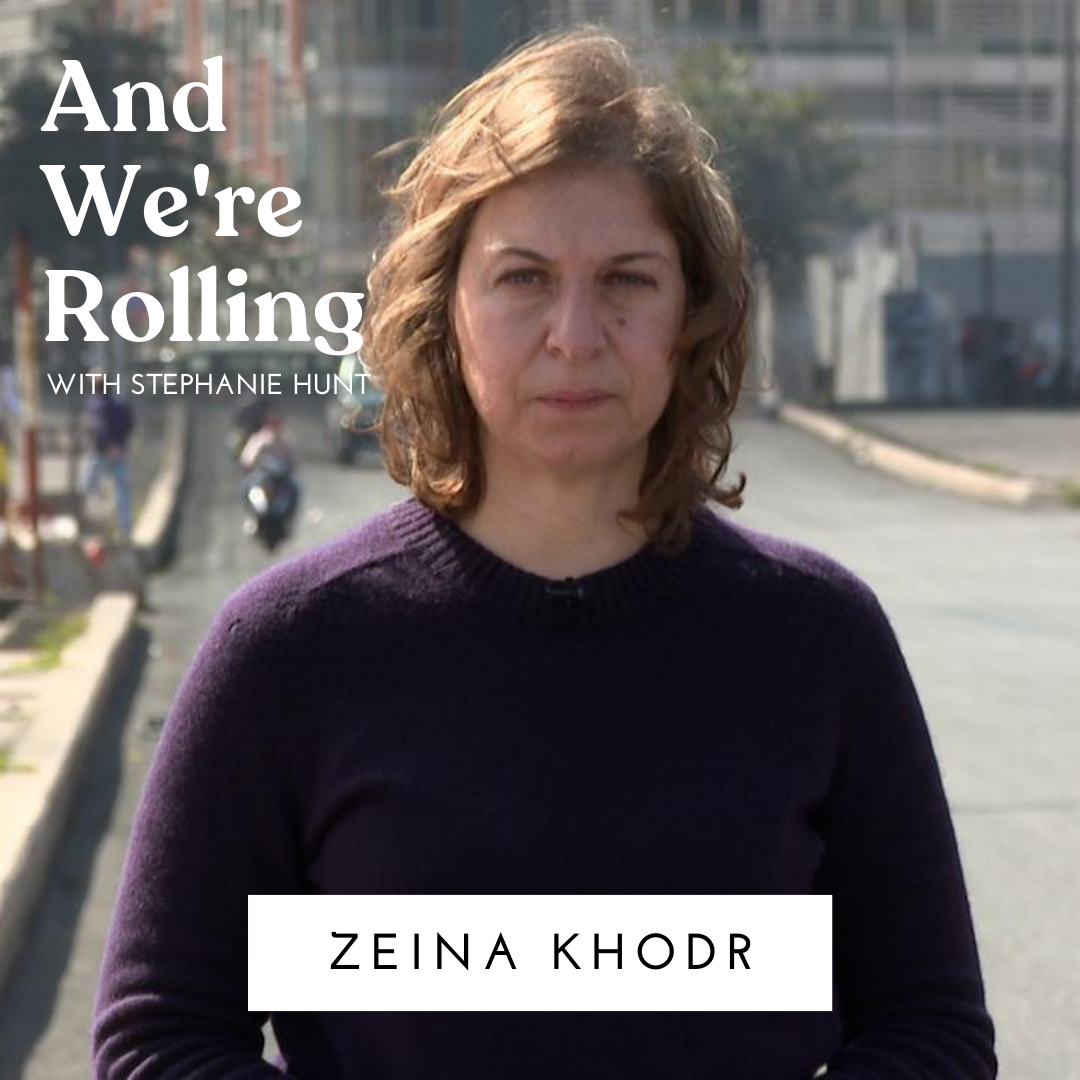
Transcript: Zeina Khodr on War Zones, the Beirut Blast, and Finding the Grit to Keep Going
And We're Rolling with Stephanie Hunt
STEPH: Zeina Khodr, welcome. I'm very honoured and very excited to have you on today.
ZEINA: Thank you so much for having me.
STEPH: Firstly, congratulations to you and the Al Jazeera team for your reporting of the Beirut explosion. You were out with your three-year-old when the blast occurred?
ZEINA: Yes, I was. I was walking with my son Theo and my mother. It was just another afternoon. I'd even just bought him a pair of shoes. There's an open area close to the American University Hospital where he likes to play, so we were there. It was nearly 6 o'clock. He was running around and I was sitting on a bench with my mum, then we decided it was time to go. He said, "No, no, no — wait a bit." So we waited a few more minutes, then got up and started to walk.
We hadn't reached the street when we heard this thud. The immediate reaction in Lebanon is to look up at the sky, because Israeli planes had been violating Lebanon's airspace and we were used to that. So people around us thought it was a mock air raid — everyone looking up, asking each other, "Is that a mock air raid?" And then moments later, a big bang.
I've never heard anything like it. I've heard a lot of explosions — not just in Lebanon but in other countries — but nothing like this. I just can't describe the sound. And then, just like in the movies, you actually see the pressure, the wind, coming towards you, and the glass in front of you shattering.
All I could hear was Theo screaming: "I'm afraid, I'm afraid." I looked to the side and saw him pushed to the ground, and I was being thrown to the ground by the pressure. Then I looked up and saw this orange smoke — a plume of orange I have never seen before.
Everyone's reaction at the time was: this is an explosion, it's an assassination. People were confused. Nobody knew what it was. My reaction — I don't know if it was right or wrong — was to take my phone, photograph the smoke, and call my husband who was in Doha. I said, "Look, we're fine. There's a massive explosion. I don't know what it is. If you need to talk, call Mum's number — my line is going to be busy." He said, "Yes, I know."
Then I called the desk. Uday was on. He's someone I've worked with in war zones, so his voice is always comforting. He asked what it was. I said I didn't know. He heard Theo screaming, heard my mum screaming. He said, "Get them home. Just get them home." I said, "I know, but I need to know what this is — if I walk down the street, there could be a second explosion." We're trained for that. You wait, because there can be a follow-up.
Then I said, no — I have to get them home. It just doesn't make sense to stay. I saw a doctor walking out of the hospital and my mum grabbed him. He just looked at her, shell-shocked. People were running inside the building and the security guards were saying don't go indoors, stay outside.
I told Uday I was taking them home — it's a matter of minutes, I'll call back. So we walked over glass, past people screaming. Some had blood on their faces. Theo was crying and screaming. I've been through this before, working in Afghanistan, in Iraq — so many times you hear an explosion and you're alone and you just know what to do. But here you are with your mum panicking, and your son who just doesn't know what the hell is going on.
It was a 500 to 600 metre walk, but I couldn't walk because of the glass everywhere. I saw a taxi and just looked at the driver. I said, "Please, just down the street." He said, "Can't you see what's happening?" I said, "Please, just down the street." I gave him some money, put my mum and Theo in the car. It was a three or four-minute drive. I put them home, closed the door, and started running towards the office.
STEPH: How do you continue to report when you're seeing your own city torn apart?
ZEINA: It's what we do. It's what I love to do. It's not an 8 to 5 job — it becomes part of your life. You have this sense of responsibility to tell the world what has just happened. And being that it's my city — well, I don't think that changes it. If I was anywhere else, it would be the same feeling. I can still remember the faces in the street, the shock. The Lebanese are used to this — years of war, and even after the war ended, assassinations, bombings. The first thing you do is call your family: are you fine, where are you? Then the phone lines jam.
Nobody knew what had happened. Nobody had any clue. The glass was in every street, the damage was everywhere. And I wasn't on the front line — I was three kilometres away. What about those people living 500 metres from the port? The children in buildings facing the port? Those who survived — what kind of trauma are they going through?
I can tell you from Theo: months later, he won't walk down that street without telling me, "No, Mummy, we go a different way." I say, "But why?" He says, "Explosion. Explosion." A three-year-old who knows the word explosion. When we go for walks and there are still pieces of glass in some streets, he points and says, "Look, Mummy, more glass, more glass." And if it's windy, he asks me, "Why is there so much wind?"
And I wasn't on the front line. Three kilometres. Could you imagine the children who were one kilometre away — in Gemmayzeh, in Mar Mikhael?
STEPH: I want to say that you are something of a legend at Al Jazeera and in the wider community. When I was working at Al Jaz as a programme editor, I'd be in the control room in Doha and look up and see you on the Syrian border. You always had such strength and focus and resolve, very little ego or fanfare — just a real respect for the job and for the story you were about to tell. How do you stay so grounded and focused?
ZEINA: To say I don't get scared would be lying. Of course I get scared. Every single human being does, and I think it's what keeps you alive. It's all about calculating the risk, understanding how far you're able to go. I'm sorry, but it's not about standing on the front line saying "there's a sniper up there" and moving forward anyway. Every conflict, every battle has a political story behind it. If you fail to give that political story, then the battle really is just another battle.
In Syria, the battle for Aleppo was essentially the end of the opposition having any strength in political negotiations. The political background of every battle is different. So why do I go close? Because I don't want to stand on a roof, read a Reuters wire, talk to two people, and just repeat after them. I want to feel the story. I want to understand what these people are going through — otherwise, why am I doing what I'm doing?
Being close gives you the strength to report, because in the back of your mind you've seen that man or that woman living next to the front line who can't move because they have no money, who can't feed their children because they've lost their work. You're speaking on their behalf, in the hope that one day there will be justice, in the hope that the international community will do something. At least you're doing something.
Yes, I get scared — but when I'm working, I just focus on the job. Not on what could happen. Of course it's in the back of your mind, but it cannot control you. When you're comfortable with yourself and you feel you don't need to prove anything to anybody apart from doing your job well, then you can do your job.
I've worked with younger colleagues who'll say, "No, no — we can move there and get a better shot." I say: if we move there, can we speak? Can we do our job? No. So what are you trying to prove? That you'll go and stand in front of the tear gas? This is not about you. This is about giving the audience an idea of what is going on. You can do that 500 metres away and stay alive — or 200 metres away and get hurt. Think it through.
STEPH: Are there still people who think women are a liability in a danger zone?
ZEINA: I've been asked this time and again: what does it mean to be a female journalist? My answer is, I don't like to differentiate. I'd rather be asked what it means to be a journalist — because there are brave men and men who are not brave, and there are brave women and women who are not. It depends on the person. And there are people who don't like to report from the battleground, but that doesn't make them a bad journalist. They could be reporting on politics or corruption and doing a better job than those in the war zone.
Some people are just lazy and think they can tell the same story from a hotel room. Well, you can't. It's the little stories — the people you meet along the way.
That road to Tripoli, for example — we had no idea we would end up reporting from the Libyan capital. We woke up in the morning, went down to Zawia. The front line didn't seem to be moving. It was just another day. Then a team member said, "Let's just drive down to the front line and see what's going on — I'm hearing chatter." So we went, and the front line had moved. The rebels were advancing.
I called the desk and said we needed to update the package — the front line had moved. Let's do a live shot and see what happens. And then that kept happening, hour after hour, pushing further and further down that highway. Until it was almost 10 o'clock at night and we were at the edge of the capital. I heard myself say we were seven or eight kilometres from the city centre. That's when it struck me.
I said to myself: there's no way, it's almost midnight, they're not going to storm the city. And then they actually did. And we followed them in and reported from what Gaddafi called Green Square — that night renamed Martyr Square by the rebels. Alex Crawford and her team entered the capital as well, as did Sara from CNN. It was history in the making.
As we drove through the neighbourhoods on the way to the main square, people were rejoicing in the streets, distributing sweets. One man came up to the car and said, "I know you — I was watching you. You were in Zawiya, giving us hope. We were counting the days until the rebels reached Tripoli. Come, stay in our house tonight." We couldn't, of course. But you watch history unfold and look at people's faces.
An old man came to me — broken English — and said on air: "Freedom. 41 years. Now we are free." Those words. I just looked at him and realised what had happened.
STEPH: How does your family deal with the dangerous scenarios?
ZEINA: My mum got used to it. When I started travelling to places like Afghanistan and Iraq, I used to tell her, "I'm coming back with a beautiful carpet." I used to bribe her. But she understood, and she supported me. Without that support I wouldn't have been able to do what I do.
In the Middle East you hear stories about women being married off early, even in so-called educated families. We never had that. Perhaps because my father died when I was around 18 — so you have to take care of yourself, take on responsibility. And I was born and raised in the Philippines; we came back to Lebanon in '85 during the height of the civil war. So we lived through that. You learn to take care of yourselves early.
My husband works in the operations department and totally understands what I do. Even during the explosion — when I reached the port and managed to speak to him in between the live reports — I started telling him, "I can't believe what happened. If I'd been down the street, maybe we would have lost Theo." And he just said: "Stop it. What are you doing right now?" I said, "I'm outside the port." "Exactly. You do your job now. Deal with this later. You guys are fine." I didn't get panic. I got: close the phone, do your job, it's fine.
That kind of attitude allows you to continue. And I'll say it — you don't get many men in the Arab world like that. You don't get many men like that anywhere in the world. Trying to control a woman, to belittle her, to undermine her confidence — it's not just an Arab world thing. There are Western men exactly the same way. I'm very thankful I don't have that. And anyway, I wouldn't have accepted anything less.
STEPH: How do you look after yourself? Do you ever switch off?
ZEINA: It's very hard to switch off. I'm constantly checking Twitter, seeing if something's happening. I like to be prepared — I don't like to be surprised. And since I cover more than one country, I need to always stay current. But I enjoy reading about politics. It's not a duty — it's a leisure. When I sit down, I just read articles. I watch the news across different channels.
Downtime — I go for walks. But yes, it just takes over you.
STEPH: Any advice for women who feel really nervous on camera, speaking to an audience, or trying to find their voice?
ZEINA: Don't think about it. I'll be honest — I don't have all the confidence in the world. I don't like public speaking. I feel, "Oh my God, why is everyone looking at me?" But camera is different because you're doing your job. It's automatic — it's like being in a bank issuing a cheque.
I think what's important is that you're telling somebody else's story. You have a responsibility to that — to be accurate, to do it justice. Yes, you make mistakes because we're human. I constantly beat myself up: I didn't say that, I forgot that point. But you do your best. And when you enjoy what you do and you feel that you're doing something meaningful, that's what gives you the confidence.
Otherwise you're just one of those people who likes to be heard.
STEPH: Zeina Khodr, I admire you so much. Thank you. I am truly honoured.
ZEINA: Thank you, Steph. Thank you so much.
And We're Rolling is hosted by Steph Hunt and produced by Stephanie Hunt Media and Habari Productions. You can follow us on Instagram and Facebook. If you enjoyed this episode, please subscribe, rate, and review. Thanks for listening.